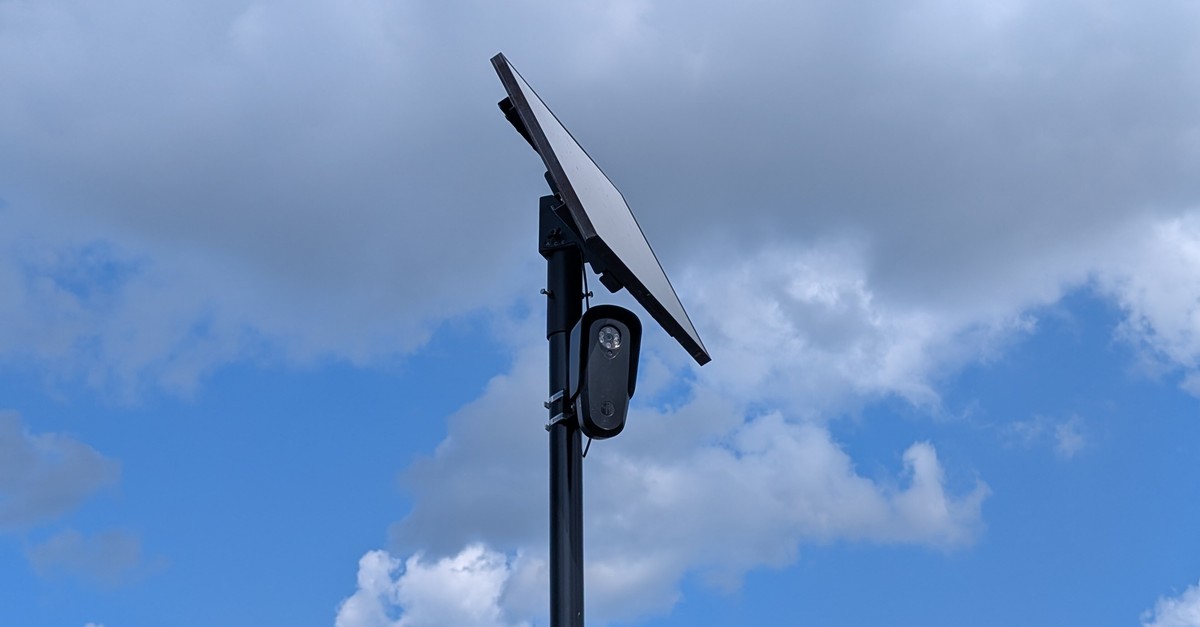
You've probably seen them: small white-and-black boxes bolted to poles at intersections, each with a solar panel on top. Ohio has roughly 6,800 of them, more than all but five other states. They read every license plate that drives past and log where and when it was seen.
They're made by Flock Safety, an Atlanta company that has grown from a Y Combinator side project in 2017 into a $7.5 billion surveillance network operating in more than 6,000 communities across 49 states. The company says its cameras perform more than 20 billion vehicle scans per month. Opponents have torn the cameras down, firebombed them, and rammed them with trucks. City councils have voted to ban them; the Ohio governor's race is fighting over them; President Trump says he likes them; both parties in Congress are investigating them; and there's a Senate hearing scheduled this week.
Few technologies divide people this cleanly. Here's the deep dive, with both sides argued as strongly as their best evidence allows.
What Flock actually is
Before the arguments, the facts. A Flock camera is an automated license plate reader (ALPR). It photographs the rear of every passing vehicle and uses computer vision to extract the plate plus a "vehicle fingerprint": make, model, color, bumper stickers, dents, roof racks, temporary tags. That data — plate, description, time, GPS location — is uploaded over cellular to Flock's cloud, searched against watchlists (stolen vehicles, Amber Alerts, wanted persons), and shared across the network of police agencies, HOAs, and businesses that subscribe.
Key details that rarely make it into the debate:
- It is not a traffic camera. Flock doesn't issue tickets. It's built for investigations and alerts.
- It's a subscription, not a purchase. Roughly $2,500–$3,000 per camera per year, hardware, installation, data storage, and maintenance included. Public records show city contracts ranging from a few thousand dollars to over $772,000 a year for big deployments.
- The network is the product. One agency's cameras don't just help that agency — users can search across the whole network, which is why Flock calls it a "national network."
- It's grown beyond plates. Flock now sells Condor pan-tilt-zoom cameras that can automatically track people and zoom on faces, Raven gunshot detectors that now also listen for "human distress," police drones launched from remote docks, and an AI search tool (OS Investigate) that prosecutors describe as a one-command background check pulling in commercial data like phone numbers and relatives. Flock says its plate readers do not use facial recognition — the LPR cameras are built to look at the rear of vehicles — but its other products reach well past plates.
That expansion matters to both sides, and we'll come back to it.
The case FOR Flock (the public-safety argument)
It recovers stolen vehicles at a scale nothing else matches. An independent working paper by University of South Carolina criminologists Ian Adams and Scott Mourtgos — the only large quasi-experimental study of fixed ALPRs to date — used staggered deployments across 216 police departments and found Flock adoption was associated with an 11 percent drop in motor vehicle theft and a 16 percent increase in motor vehicle arrest clearance rates. They also found faster recovery times: the median time to recover a stolen car fell about 7 percent. A caution worth stating: the authors themselves note a pre-existing downward trend in some departments before cameras arrived, so part of the effect may come from other police activity. Still, this is the strongest independent evidence available, and it points in Flock's favor for its core use case.
Flock's own 2025 impact census (company-reported survey data, so take it as such) says 42 percent of responding agencies reported that Flock was involved in recovering half or more of the stolen vehicles in their jurisdiction.
It's a force multiplier for small departments. A rural or small-town agency with three officers on duty can't watch every road. A camera that flags a stolen plate the moment it crosses the village line gives them something they could never do alone. Suburban Atlanta's The Villages went from stopping a few stolen vehicles a year to recovering more than 50 in two years, including over $1 million in recovered cars. Cleveland credited license plate readers with helping in 139 investigations — identifying suspect vehicles, tracing travel patterns, connecting suspects to scenes.
It solves crimes that otherwise go cold — including the worst ones. The case studies the pro side leads with are genuinely compelling: an Atlanta-area toddler kidnapped with her mother's stolen car and recovered within 15 minutes of the car being flagged; abductors and hit-and-run drivers traced across state lines within hours. Anyone who runs the "stolen car with a child in the back seat" scenario in their head understands why chiefs and sheriffs love these boxes. It's also worth noting the technology works both ways — defense attorneys use the same location data to prove clients were nowhere near a crime, and documented cases exist of Flock data clearing innocent suspects.
The economics are favorable. At $2,500–$3,000 per camera per year, a single prevented motor vehicle theft — which costs victims roughly $10,000 and the justice system another $6,000 on average — pays for five or six cameras in social cost terms.
The pro side's strongest overall point: this is a targeted tool for crime that is disproportionately vehicle-based, deployed at a price small towns can afford, and the independent evidence that exists supports it for its narrow purpose.
The case AGAINST Flock (the privacy and civil-liberties argument)
It surveils everyone, not just suspects. This is the heart of the objection. The ACLU's position, stated plainly: "There's no reason the technology should be used to create comprehensive records of everybody's comings and goings — and that is precisely what ALPR databases like Flock's are doing." The numbers back it up: a frequently cited analysis of Maryland plate-reader data found only 0.2 percent of reads were ever associated with any crime or even suspicion of one; the same analysis of Minnesota State Patrol data found 0.05 percent of reads led to a citation or arrest. In plain terms: almost every single read is of an innocent person. And those reads are searchable history — where you were, when, for how long.
The accuracy record is genuinely bad, and innocent people pay for it. An IPVM test in 2021 found a 10 percent error rate in Flock's camera output (Flock disputed it and halted sales to IPVM). Business Insider reported that Roseville, California police found 71 percent of the 1,427 stolen-vehicle alerts Flock sent them in 2023–2024 were incorrectly identified plates — and the department kept stopping one driver whose plate Flock repeatedly misread. The human cost is documented across the country, including close to home:
- Toledo: police detained an innocent driver at gunpoint, sicced a K-9 on him, and jailed him for hours after a Flock camera misread a "7" as a "2."
- Volusia County, Florida: a 23-year-old woman was wrongfully arrested and held 13 days (part of it in solitary) after Flock misidentified her car's color and tag in a fatal hit-and-run investigation.
- San Diego: a man was jailed nearly a month after Flock mistook his plate for one at an attempted carjacking.
- Tennessee: grandparents were detained at gunpoint with their three-year-old granddaughter watching, after a Flock camera misread an "O" as a "0."
Police misuse has been rampant and the guardrails were optional. The Institute for Justice documented 28 cases since 2024 of officers using Flock to stalk people — mostly ex-partners. A Sedgwick, Kansas police chief tracked his ex-girlfriend's car 228 times. A Milwaukee officer ran almost 180 searches on a woman he was dating. In Ohio, two Reynoldsburg officers resigned rather than face internal affairs after repeatedly searching plates unrelated to any investigation. The damning detail: Flock's audit tool was opt-in until August 2026, and only about a third of police customers used it — even though the company says it knew misuse was a risk nine years ago. Audit Assistance is now mandatory by the end of 2026, and an EFF audit found its flags could be dodged by entering gibberish like "LMAO" as the search reason. The ACLU says the tool's effectiveness has never been independently verified and calls it "window dressing." (For balance: 13 states now require audits and 8 states make misuse a standalone crime — the guardrails are tightening, after the damage was done.)
The data flows out of your town, and it has reached ICE. Flock's architecture lets one agency share queries across the whole network — which is powerful for solving crime and also means data collected in Ohio can be searched from anywhere. In 2025, a Flock pilot with Customs and Border Protection and Homeland Security Investigations for human trafficking and fentanyl cases was halted by Flock after "confusion and concerns." But indirect access continued: a lawsuit over San Francisco's Flock data found FBI, ICE, CBP, ATF, DEA, and U.S. Postal Inspection all queried it — 1.6 million times in seven months — despite California law explicitly banning such sharing. The ACLU says Flock has repeatedly misled cities about federal access; Flock says customers control their data and it never shares on customers' behalf without permission. In one Texas case, a sheriff's office investigating a self-managed abortion queried the network across 83,000 cameras — including in states where using such data for that purpose is illegal.
Scope creep is the other side's second fear. The company line — "we focus on vehicles, not people" — was built into the cameras' design (they photograph the rear of cars specifically to avoid faces). But Flock now sells AI search that pulls in arrest records, dispatch logs, and commercial databases with Social Security numbers, birth dates, and relatives; Condor cameras that zoom on faces; drones that look into backyards and through windows; and a gunshot sensor that now listens for screaming. Privacy groups argue this isn't the same product it was in 2017, and public records requests show police using Flock's search tools for characteristics of individuals — race, gender, clothing, tattoos, even perceived political affiliation.
Security has been a real problem. In 2025, researchers found hardcoded credentials and exposed debug interfaces in Flock cameras. In December 2025, 404 Media found 60 Condor cameras exposed to the open internet — anyone could watch live feeds, download 30 days of archived video, and change settings. Hackers have physically ripped cameras off poles and extracted their data and software. For a system whose entire value is knowing where everyone is, these are not academic concerns.
And the governance has been messy even where the technology is popular. Cameras have been installed without city or property-owner consent (Roanoke: 30 of 41 devices placed in unapproved locations; Littleton, Mass.: cameras allegedly switched back on after being disabled), and kept running after contracts expired (Cleveland's cameras stayed on and were used by police after the council voted 3–1 not to renew; Verona had to cover its cameras in trash bags to get Flock to remove them). Critics also note the network is often funded by private donations and HOA money rather than public votes — surveillance installed without the usual democratic process.
What both sides actually agree on
Here's the part that gets lost in the shouting. Dialogue between advocates and policymakers has produced real consensus points, and Flock has already moved on several:
- Retention should be short. Flock cut its default data lifespan from 30 days to 7 days under public pressure. Everyone from the ACLU to the Manhattan Institute agrees: long retention is where tracking becomes "dragnet."
- Audits must be mandatory, and misuse should be criminal. Flock made Audit Assistance mandatory by end of 2026; 13 states require audits; 8 make misuse a standalone crime. Both poles want this — the argument is only about whether the tools actually work.
- Historical searches should need more than a casual query. Courts are actively wrestling with this. A Virginia trial court ruled in 2024 that warrantless collection from 172 Flock cameras violated the Fourth Amendment; appellate courts have generally upheld ALPR use so far. The Supreme Court's 2026 Chatrie ruling — extending warrant requirements to long-term location data — has privacy lawyers on both sides expecting more litigation.
- No cameras near sensitive places. Churches, clinics, schools, and medical facilities are where even police supporters accept restrictions. Texas and Florida have moved to restrict ALPRs statewide; Florida banned them from state highways.
- Transparency. Camera location maps, published audit logs, and clear data-sharing agreements. Flock says it's increased transparency; critics say there's a long way to go.
The pragmatic middle position — argued most thoroughly by the Manhattan Institute, a right-leaning think tank that nonetheless rejects the "ban them all" impulse — is: don't ban the cameras; regulate them. Mandatory logging, supervisory approval, retention limits, criminal penalties for misuse, restrictions to major crimes, and no cameras near sensitive places.
The bottom line
If you strip away the dueling adjectives, the fight is about two honest questions:
Does it work? The best independent evidence says yes for its core purpose — fewer stolen vehicles, faster recovery, better clearance of vehicle crimes. The company's broader marketing claims (its "700,000 crimes solved a year" figure is a company estimate from its own framework, not an independent count) deserve skepticism.
Is the price acceptable? The price isn't money — it's a searchable record of every car on your roads, collected without suspicion, with documented accuracy failures that have put innocent people in handcuffs, a documented officer-misuse problem that is only now being audited, and a data-sharing network that has demonstrably reached federal agencies. That's a real cost, and it's paid mostly by people who have done nothing wrong.
Both statements are true at the same time. That's why this debate refuses to die, and why it's now a national political fight — including in Ohio, where the governor's race is actively arguing about it.
If your town, school district, or church association is being asked to fund a camera network — Flock or otherwise — the questions worth asking before anyone signs:
- How long is data kept, and who can access the raw records?
- Are searches audited automatically, and does misuse carry real consequences?
- Where exactly is the camera going, and who consented?
- Who owns the data, and who can it be shared with — including federal agencies?
- Who pays, who maintains the system, and what happens when the subscription lapses?
- Is there a public vote or open meeting, or is this being funded privately?
The technology isn't going anywhere — 120,000+ cameras are already up nationwide, per the New York Times, and community maps report even more. The question for every community is whether the rules around it are as good as the marketing.
If you're weighing a surveillance, security, or technology purchase for your organization, that's a normal part of our free 30-minute IT review. No obligation, no jargon.
Sources and further reading
- Adams & Mourtgos, University of South Carolina, "Automated License Plate Readers, Vehicle Theft, and Clearance" (working paper, Aug 2026) — the 11% / 16% / 7% findings
- Manhattan Institute, "Automatic License Plate Readers: Benefits, Risks, and Sensible Regulation" (Sept 2026) — evidence review, cost-benefit, model legislation
- Flock Safety Impact Census (May 2026) and company blog — 42% recovery stat, 700,000-crimes claim (company-reported)
- New York Times (Aug 2026) — roughly 120,000 cameras deployed; "police love them, citizens don't"
- ACLU — "Tracking ALPR Cameras" series; "Flock Safety Credibility Lost" (July 2026); ICE access statements
- Institute for Justice — 28 documented stalking cases (2026); ALPR false-stop database (July 2026)
- Wikipedia: Flock Safety (company history, products, controversies, lobbying figures, funding)
- DeFlock / DeFlockUSA — community-reported camera maps: 142,566 cameras nationwide, 6,812 in Ohio (91% Flock, 556 cities, 80 counties)
- Business Insider — Roseville, CA 71% alert-accuracy analysis
- 404 Media / Wired — Condor camera exposure (Dec 2025), OS Investigate leak (Aug 2026), abortion-investigation reporting
- Brennan Center for Justice — ALPR legal status; Crump, "You Are Being Tracked" (Maryland 0.2% / Minnesota 0.05% figures)
- The Guardian (April 2026) — Mountain View, Santa Cruz, South Pasadena contract terminations
- WEWS-TV Cleveland (June 2026), Columbus Dispatch (May 2026), cleveland.com (Sept 2026) — Ohio coverage
- Newsmax (Sept 18, 2026) — Sen. Hawley's Senate hearing invitation; Reuters / The Independent (Sept 2026) — Florida highway ban, Trump's comments